In web development, ensuring a website displays well on different devices (PCs, mobile phones, tablets) is crucial. Common adaptation solutions include pure front-end responsive design, back-end user agent detection returning different templates, and hybrid solutions. This article compares the advantages and disadvantages of these three solutions in detail and provides best practice suggestions to help developers choose the solution best suited to their business needs.
Front-end responsive
technology
- Use CSS media queries and flexible layouts (Flexbox/Grid)
Features
The same codebase works on all devices
Automatic layout adjustment via CSS
We recommend using the Mobile First design principle.
Mainstream frameworks (Bootstrap, Tailwind, etc.) have built-in responsive design support.
Backend device testing
principle
- Determine device type by parsing the User-Agent header information
process
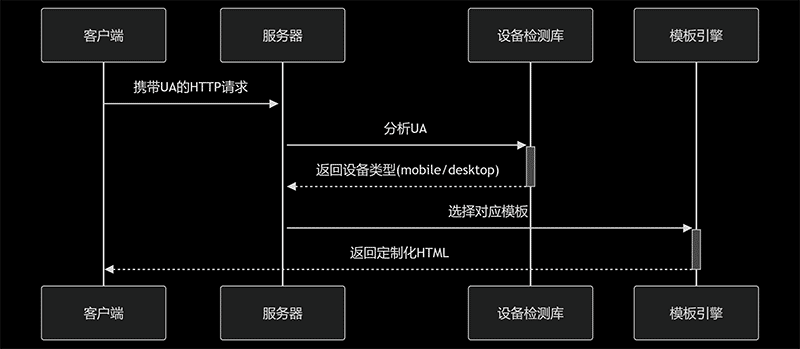
Implementation
Use device detection libraries (such as MobileDetect, UAParser.js).
Return different templates (PC: desktop.html, mobile: mobile.html)
Comparison of advantages and disadvantages of hybrid solutions
| plan | advantage | shortcoming |
|---|---|---|
| Pure front-end responsive | - Low maintenance costs - No server-side computational overhead - Responds instantly to viewport changes | - May load redundant resources - Same DOM structure for all devices - Unaware of UA characteristics (such as device capabilities) |
| Pure backend UA judgment | - Precisely return differentiated content - Highly customizable templates - Save mobile bandwidth | - UA identification error exists Maintaining multiple templates is costly. - Destroys cache consistency (requires Vary header). |
| Hybrid scheme | - Balance flexibility and performance - Deep optimization of key pages - Compatible with older equipment | - Dual maintenance costs - Caching strategy needs to be handled - Dynamic layout may cause CLS issues. |
Recommended Practices
Basic Solution
- Prioritize using front-end responsive design
Enhanced Scene
- For pages with significant differences in mobile/PC experience (such as the official website homepage), backend judgment should be used.
Optimization Techniques
Server-side Vary: User-Agent header settings
Return optimized image resources to mobile devices
Avoid duplicate checks by recording device type using cookies.
Modern Evolution
Gradually shifting to responsive and adaptive design
Dynamically enhance in conjunction with device capability APIs (such as touch support, screen size).
For web applications, an SSR+dynamic component solution could be considered.
This hybrid strategy can provide a better user experience for specific scenarios while ensuring development efficiency.
in conclusion
There is no perfect solution. A purely front-end responsive design is suitable for most scenarios, back-end user agent (UA) detection is suitable for businesses with high-performance requirements, while a hybrid solution can balance flexibility and optimization potential. Developers should choose the most appropriate strategy based on project size, team resources, and business needs.